Perpetual contracts are now a core part of crypto market activity, but they are also one of the fastest ways retail traders lose money when leverage is misused. In 2026, discussing perpetuals without discussing risk is incomplete. This article keeps risk at the center and uses BYDFi as the main case example, so readers can understand how platform features interact with real trading behavior.
The goal here is educational clarity, not promotion. BYDFi appears throughout this article because readers asked for a platform-specific explanation, but every feature is discussed through a risk lens.
What a Perpetual Contract Actually Is
A perpetual contract is a derivative tied to an underlying asset, usually a crypto pair, and it does not expire like traditional dated futures. Instead of final settlement on a calendar date, perpetual markets use recurring funding payments between long and short positions to keep contract prices near spot prices.
Three basic terms are enough for most readers:
1.Contract: the instrument being traded.
2.Margin: the collateral posted to keep a position open.
3.Leverage: borrowed exposure that multiplies both gains and losses.
On BYDFi, this same structure applies across its perpetual product line. The platform offers multiple contract settlement formats, including USDT-M, USDC-M, and COIN-M, which gives users flexibility but also adds complexity. Choosing the wrong settlement format for your risk profile can create avoidable stress during volatile sessions.
How BYDFi’s Core Perpetual Setup Affects Risk
BYDFi provides access to a broad list of perpetual pairs and supports high leverage on selected contracts. For many traders, those two points are attractive at first glance. However, broad product coverage and high leverage are neutral tools. They only become helpful when position sizing and loss control are strong.
As of May 25, 2026, BYDFi’s public product/link pages indicate roughly 500 + futures contract pages/pairs across crypto majors, altcoins, and some non-crypto themed contracts. This number is operationally useful as a coverage signal, but tradable availability can still vary by status, liquidity, and user region.
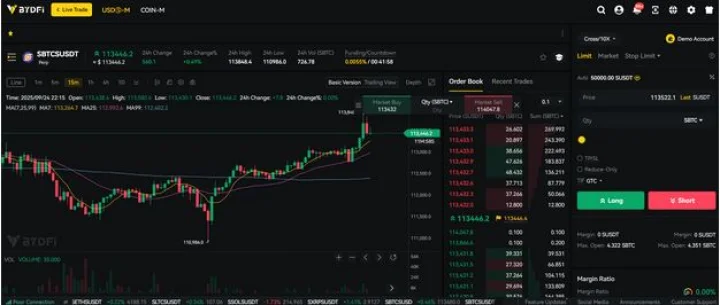
The platform’s cross-margin and isolated-margin options are especially important in practice. On BYDFi, as on most derivatives venues, cross margin can share collateral across positions and may delay liquidation on one position. But this can also put a larger part of account equity at risk during fast market moves. Isolated margin can cap exposure at the position level, yet it may liquidate more quickly if leverage is aggressive. Users who switch between these modes without a clear rule usually increase their own risk.
BYDFi also offers standard order controls such as limit, market, stop logic, and position-management tools. These controls matter because most retail losses are not caused by missing a perfect entry; they are caused by weak exit discipline. A stop-loss that is defined before entry is generally more useful than one adjusted emotionally after the market moves.
How to Choose Leverage More RationallyLeverage selection should start from loss tolerance, not profit targets. A practical sequence is:
-
Decide max loss per trade (for example, 0.5% to 1.0% of total account equity).
-
Define invalidation first (where the setup is wrong).
-
Size position from risk budget and stop distance.
-
Set leverage only after size is fixed.
A simple behavioral framework for BYDFi users:
-
Lower leverage (for example 1x to 5x): usually better for newer traders and volatile sessions.
-
Medium leverage (for example 5x to 10x): only if stop discipline is consistent and position size is still conservative.
-
High leverage (10x+): On BYDFi, leverage can reach up to 200x on selected pairs (subject to pair-specific and risk-tier limits).
The key is that “available leverage” is a platform feature, not a recommendation.
How to Trade in Different Trading Environments
Different environments require different behavior. Using one style in all conditions is a common reason for avoidable losses.
1) Demo environment (process testing):
Use BYDFi demo tools to practice order placement, margin mode choice, and stop execution workflow. Treat demo as a mechanics lab, not as proof of profitability.
2) Low-volatility environment (range behavior):
Use smaller targets, avoid over-leverage, and be careful with overtrading. Fees, spread, and funding can dominate results when price movement is limited.
3) High-volatility or event-driven environment:
Reduce size first, widen expectations for slippage, and avoid emotional re-entries. In fast moves, preserving capital is often the edge.
4) Transition environment (quiet to fast):
This is where many traders get caught. If volatility regime changes, re-check leverage, stop distance, and whether cross/isolated mode still fits your plan.
Where BYDFi Users Commonly Make Mistakes
The most common issue is over-sizing relative to account balance. A trader may open a high-leverage BYDFi position believing a small move will be manageable, then discover that normal volatility is enough to push the position near liquidation. In leveraged markets, survival usually depends more on conservative size than on prediction accuracy.
A second issue is misunderstanding cost structure. BYDFi users, like users on other venues, often focus only on quoted trading fees. But real outcomes are also affected by funding payments, spread, and slippage during execution. Frequent in-and-out trading can turn a seemingly small cost difference into a large cumulative drag.
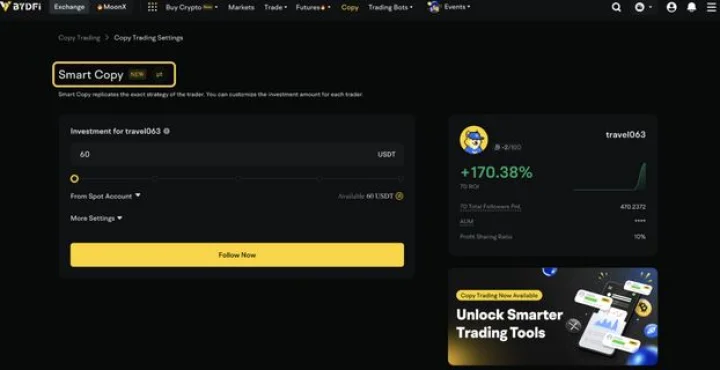
A third issue is treating copy trading as risk transfer. BYDFi’s copy-trading functionality may help users observe strategy behavior, but copying a lead trader does not remove leverage risk. Followers still face liquidation risk, timing risk, and execution differences. If a user assumes copy trading is passive income, expectations and risk can quickly diverge.
A fourth issue is emotional override. On BYDFi, traders can adjust leverage and position parameters quickly, which is convenient but dangerous under stress. Revenge trades, late-night impulse entries, and repeated averaging into losing positions are still common account-damaging patterns.
How to Evaluate BYDFi More Responsibly
Readers who want to assess BYDFi more carefully should focus less on headline leverage and more on risk workflow. In practical terms, this means checking contract specifications, funding behavior, and liquidation mechanics before placing any live trade. It also means deciding in advance whether cross or isolated margin fits your risk boundaries, rather than changing modes during panic.
BYDFi’s demo environment can be useful for this purpose because it lets users test order flow and margin behavior before committing real capital. That said, demo performance should not be treated as proof of live readiness. Live conditions include slippage, emotional pressure, and real loss consequences that demos cannot fully reproduce.
For readers comparing platforms, BYDFi should be reviewed as a full process: onboarding rules, contract availability, risk controls, fee mechanics, and operational discipline. Looking at only one metric, such as maximum leverage or promotional visibility, gives an incomplete and often misleading picture.
Regulatory Expectations and Reader Safety
Expectations around leveraged crypto products continue to evolve across markets. Supervisors increasingly focus on suitability, disclosures, and risk controls, and platforms may update onboarding or feature access requirements over time. For readers, the key point is that product availability does not automatically mean personal suitability.
Before using any leveraged product on BYDFi or elsewhere, users should check applicable local requirements, define clear loss limits, and confirm that any potential loss is financially tolerable. If these conditions are not met, the safer decision is to wait.
Conclusion
BYDFi provides a feature-rich perpetual trading environment, but features alone do not protect users from leveraged losses. The strongest protection remains disciplined position sizing, consistent exit rules, realistic leverage, and the ability to stop trading when market conditions or mental state are unstable.
Use BYDFi as a tool only if your risk process is already stronger than your urge to trade. For reference information on product details and platform updates, see
https://www.bydfi.com.
This content is for education only and is not investment advice.