Publish Date: Mon, 18 May 2026 (19:05 IST)
Updated Date: Mon, 18 May 2026 (19:20 IST)
As per RBI and FEMA guidelines, non-resident Indians need specific NRI savings accounts to
manage their finances in India. There are dedicated accounts for specific purposes, mainly
divided based on the source of income used for transactions. The two types of NRI bank
accounts are the NRE Account and the NRO Account.
Understanding how these accounts differ and their specific uses can help NRIs choose the
right savings account to manage their funds and investments in compliance with Indian
regulatory requirements.
What is an NRE account?
An
NRE account is for depositing income earned outside the country. Money in this account
is maintained in Indian rupees. The account balance is fully repatriable, meaning it can be
transferred to a bank account abroad without restrictions.
Typical uses of an NRE account are:
-
Depositing income from sources abroad
-
Parking overseas income that requires flexibility for transfer abroad
Interest earned on the balance of an NRE account is tax-free in India as per latest Indian tax
taxation laws.
What is an NRO account?An
NRO account is used specifically to manage income generated in India. These typically
include income sources such as investment dividends, rental income, or pensions.
Typical uses of an NRO account are:
-
Depositing income from Indian sources
-
Making local expenses and investments in India
Unlike an NRE account, repatriation from an NRO account is restricted after a certain
threshold and under certain regulatory conditions.
Key differences between NRE and NRO accounts
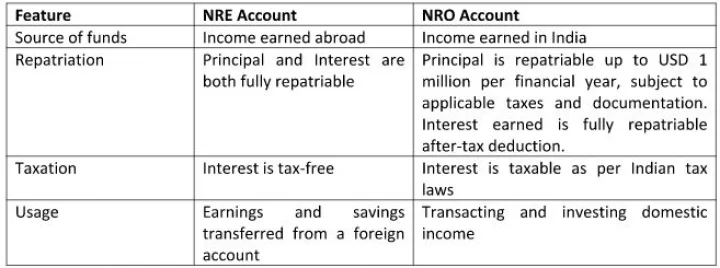
The table highlights key factors that differ between NRE and NRO accounts.
NRIs can choose the correct account as per their source of income and currency to comply
with Indian banking regulations
How to choose between NRE and NRO accounts
Non-resident Indians must choose between an NRE and an NRO account, depending on the
source of funds and how they plan to use them. They must consider:
-
Type of income: Use an NRE account for foreign earnings and an NRO account for income generated in India. Using the incorrect account type may lead to regulatory scrutiny and potential restrictions as per FEMA and bank policies.
-
Repatriation needs: If NRIs plan to transfer funds abroad, an NRE account may be more suitable.
-
Tax considerations: Interest earned on an NRO account is taxable, while interest on an NRE account may be tax-free. All account holders in India, including NRIs, must comply with the income-tax laws and the RBI's banking regulations.
Sometimes, NRIs use both accounts together to manage different financial commitments.
Using both accounts together
Rather than choosing one over the other, many NRIs maintain both an NRE account and an
NRO account.
The benefits of maintaining both accounts are:
-
Dedicated accounts for foreign and domestic income
-
Transacting in Indian rupees for domestic spending
-
Stay compliant with repatriation laws
-
Avoid penalties for using the wrong NRI account variant
Using both accounts together provides an efficient account management system.
Choosing the right account with suitable features
When selecting an account, consider factors such as ease of access, digital banking features,
and account flexibility. For instance, IDFC FIRST Bank offers both NRE and NRO accounts for
NRIs, with digital onboarding, zero banking fees, competitive interest rates, video KYC,
document verification, and seamless account management via the mobile app and online
banking. These accounts can help manage financial needs through a single banking
platform.
Making the right choice for your financial needs
Both the NRE account and the NRO account serve specific purposes in NRI banking. While
the NRE account is suited for foreign income and repatriation, the NRO account helps
manage income earned within India. Understanding these differences allows NRIs to
structure their finances more effectively and choose the right combination based on their
needs.